
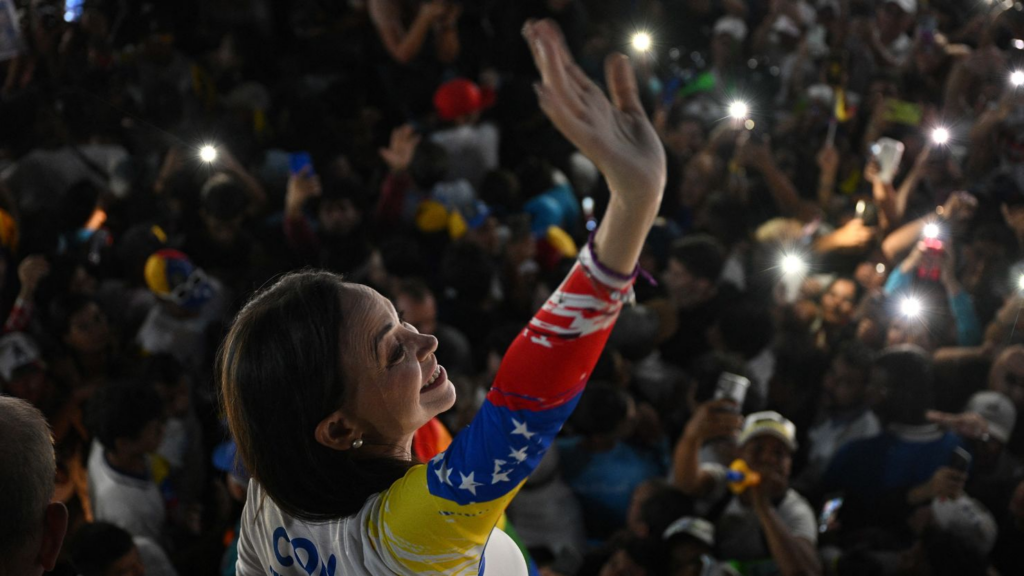
Venezuela’s opposition has found itself at a critical juncture, navigating the tumultuous waters of a political landscape dominated by figures like Delcy Rodríguez, the recently sworn-in interim president, while seeking leadership from influential voices such as María Corina Machado. After years of turmoil under the Chávez-Maduro regimes, the question arises: Does the opposition still hold any sway in Venezuelan politics? Machado’s charismatic rise to prominence had initially unified a fragmented opposition, but facing government repression and exclusion from electoral processes, her role has become increasingly complex. As Rodríguez symbolically consolidates her power with backing from the military, the urgency for Machado and her supporters becomes more pronounced. Amidst allegations of electoral fraud and violence against dissenters, the fate of Venezuela’s future may hinge on whether the opposition can reclaim its voice against an entrenched establishment.
The political landscape in Venezuela reflects a stark divide between the ruling establishment and those who oppose it, commonly referred to as the dissidents. While the newly appointed leader, Delcy Rodríguez, navigates her reign with the military’s support, opposition forces, particularly those rallied around the figure of María Corina Machado, are grappling with their diminishing influence. The challenges for these dissenters are compounded by state-sanctioned violence and the systematic silencing of voices that call for political reform. As the nation stands at a crossroads, understanding the dynamics between these opposing forces becomes crucial in assessing whether change is on the horizon. Amidst an atmosphere of desperation and hope, the question remains: can Venezuelan democracy find a way through this impasse?
The Rise of Delcy Rodríguez in Venezuelan Politics
Delcy Rodríguez has swiftly emerged as a formidable figure in Venezuelan politics following her swearing-in as interim president. A seasoned lawyer and a close associate of Nicolás Maduro, Rodríguez embodies the essence of Bolivarian socialism, making her an emblem of the existing political structure. Her first appearance as leader was marked by the presence of powerful military figures and her brother Jorge Rodríguez, which underscored the continuity of Chavismo in Venezuela’s governance. Observers note that her ability to maintain the support of the military, which has a stronghold over the country’s key sectors, will be pivotal as she navigates a complex landscape dominated by power struggles and external pressures from Washington.
Furthermore, the political climate in Venezuela is characterized by deep divisions, and Rodríguez’s pragmatism may be her greatest asset. By balancing her loyalty to the Chavista doctrine while appeasing U.S. interests, she seeks to stabilize her rule. However, internal dissent among military leaders, each with their own financial interests, poses a significant challenge. As economist Manuel Sutherland remarked, her popularity amongst the armed forces is uncertain, potentially jeopardizing her capacity to govern effectively. Thus, Rodríguez’s tenure will be a delicate balancing act between maintaining support from Chavismo and assurances to foreign powers.
The geopolitical dynamics further complicate Rodríguez’s leadership. After the recent U.S. military intervention, which was a critical moment for Venezuela, the nation’s political fate seems entwined with U.S interests, particularly regarding its oil resources. The substantial offer of Venezuelan crude oil to the U.S. underscores a transactional relationship rather than a genuine commitment to democracy. This entangled situation raises concerns about the future of sovereignty in Venezuelan politics and the potential for further foreign intervention masquerading as aid.
Machado’s Resilience Amid Political Turmoil
In stark contrast to Rodríguez, María Corina Machado represents a significant but sidelined voice within Venezuelan opposition politics. Despite her unwavering charisma and ability to rally a substantial majority around her vision for Venezuela, Machado’s aspirations were thwarted when she was barred from running in the 2024 elections. This political maneuvering served to underline the establishment’s determination to maintain power, reflecting the entrenched resistance to genuine democratic processes in Venezuela. The proliferation of Edmundo González Urrutia as a substitute candidate further illustrates how the regime sought to undermine Machado’s influence and maintain the status quo.
Machado’s decision to go underground following the government’s crackdown on dissent highlights her perilous position within a system that utilizes fear and repression to quash opposition. Despite these challenges, her recent public re-emergence in Oslo to accept the Nobel Peace Prize signals her determination to continue advocating for change, even if it means embracing controversial partnerships. In a provocative statement, she signaled her desire to share the award with U.S. President Donald Trump, indicating a complicated relationship with foreign powers that could be instrumental in shaping Venezuela’s political future.
While Machado’s popularity soared in the lead-up to her candidacy, her absence from the political battlefield has led to questions about her effectiveness as a leader. Many Venezuelans view her as a symbol of hope; however, her limited influence over the military, a crucial component of any power shift in Venezuela, significantly undermines her position. The military’s ingrained role in politics and commerce places Machado at a disadvantage, as she lacks pathways to leverage the armed forces for support, a stark contrast to Rodríguez’s established connections.
The Military’s Role in Venezuelan Power Dynamics
The Venezuelan military has long been a key player in the nation’s political landscape, with its intertwining interests in both governance and business. For any political shift to occur, it is essential to understand the military’s influence and how it shapes the dynamics between leaders like Delcy Rodríguez and María Corina Machado. Under Maduro’s regime, a significant number of high-ranking generals have been granted power and privilege, which has solidified their loyalty to the current government. Rodríguez’s rapport with these military figures will be crucial as she attempts to navigate the fine line between satisfying their demands and asserting her own authority.
In contrast, Machado’s supporters largely comprise civilians and protestors, and she commands no substantial backing within the military ranks. This disconnect has left her vulnerable to the regime’s machinations, underlining the importance of military allegiance in Venezuelan politics. Without the active support of the armed forces, Machado’s push for reform becomes increasingly difficult, revealing the immense challenges facing the opposition.
Moreover, the military’s control over critical sectors, including oil and food distribution, ensures that they remain indispensable in any political equation. This reality complicates Machado’s position, as any strategy for effecting change must consider not just public sentiment but also military dynamics. Until the military’s stance shifts, any aspirations for a political transition away from Chavismo remain speculative at best. Rodríguez, aware of this power dynamic, skillfully appeals to both her military contacts and the international community, leaving Machado to fight for relevance from political exile.
U.S. Influence and Its Impact on Venezuela’s Politics
The influence of the United States on Venezuelan politics has been palpable and, at times, detrimental to the prospects for a legitimate democratic transition. In the wake of the U.S. military attack, both Delcy Rodríguez and María Corina Machado find themselves navigating a landscape heavily shaped by American interests, particularly surrounding oil resources. Rodríguez’s overtures towards the U.S. signal her understanding of the need for international cooperation, especially in a nation where economic sanctions have drained resources and exacerbated humanitarian crises. The promise of oil deals to the United States highlights an attempt to appease external pressure while negotiating the complexities of domestic allegiance.
Conversely, Machado’s reliance on U.S. backing illustrates the duality of her position—representing a faction that believes in foreign intervention as a necessary evil while ironically also casting her as someone influenced by external forces rather than true national interests. This continues to stifle her credibility domestically, while select factions view her as a puppet of American ambitions, complicating her image as a patriotic leader fighting for Venezuelan liberation.
As the political climate evolves, U.S. intentions become increasingly scrutinized. With Donald Trump’s administration actively seeking to secure Venezuelan oil, it begs the question of whether immediate foreign aid translates into lasting political reform or merely serves the geopolitical interests of outside powers. Both Rodríguez and Machado must grapple with the consequences of external meddling: for Rodríguez, it’s about maintaining legitimacy while catering to foreign demands, and for Machado, it’s about restoring her credibility while not compromising her support base by appearing overly reliant on U.S. validation.
The Divergence of Political Paths: Rodríguez vs. Machado
The divergent trajectories of Delcy Rodríguez and María Corina Machado illustrate the complexities of Venezuelan politics, characterized by entrenched power struggles and contrasting ideologies. Rodríguez, tethered to the traditions of Chavismo, seeks to secure her position by aligning closely with established military leaders, emphasizing stability amidst uncertainty. Her immediate task revolves around consolidating power in the face of potential dissent while engaging with international forces eager to exploit Venezuela’s resources. This calculated approach positions her as both a defender of the current establishment and a negotiator open to some aspects of foreign commerce.
On the other hand, Machado’s path is fraught with obstacles. Despite her initial momentum, her exclusion from the electoral process exposes a fragile opposition fractured by fear and state-sponsored violence. While supporters see her as a beacon of hope for systemic change, the lack of legislative platforms and military backing leaves her at a critical disadvantage. The contrasting fates of these two women reflect the broader narrative of Venezuela—a nation caught between the claws of entrenched dictatorship and the yearning for a democratic awakening.
This stark contrast in political paths not only highlights the challenges facing each leader but also draws attention to the struggle for identity within Venezuelan society. Rodríguez’s ability to resonate with the military and bourgeoisie offers her a temporary foothold, while Machado’s connection to the populace articulates a deeper desire for reform that may, at some point, galvanize widespread support. The resolution of this political dilemma rests on the Venezuelan people, who continue to yearn for a leader who can unite the country, transcending the divides that have allowed individuals like Rodríguez and Machado to embody two disparate visions for the future of Venezuela.
Frequently Asked Questions
What challenges does María Corina Machado face in Venezuelan politics against Delcy Rodríguez?
María Corina Machado faces significant challenges in Venezuelan politics, primarily due to the support of the military behind Delcy Rodríguez. Despite her popularity and strong leadership in the opposition, Machado’s exclusion from the 2024 elections and lack of military backing hinder her ability to influence change in the current political landscape.
How has Delcy Rodríguez consolidated power within Venezuela’s Opposition and military?
Delcy Rodríguez has consolidated power by securing loyalty from the military and maintaining a unified front with key political figures. As the current interim president, she demonstrates a pragmatic approach to governance, balancing Chavismo’s demands and seeking cooperation with international powers, particularly the U.S.
What impact does U.S. foreign policy have on the dynamics of Venezuela’s opposition?
U.S. foreign policy greatly impacts Venezuela’s opposition, as seen in the current dynamics between María Corina Machado and Delcy Rodríguez. The U.S. support for certain political figures alters the power balance, with Machado previously hoping for backing after military interventions. However, the U.S.’s intentions appear driven by resource interests rather than a commitment to democracy.
Does María Corina Machado have a viable path to regain political influence in Venezuela?
While María Corina Machado has demonstrated considerable political charisma and garnered public support, her path to regaining influence is obstructed by the military’s backing of Delcy Rodríguez and her own marginalization from the elections. The future of her political influence will depend on changing circumstances and potential shifts within the military’s allegiances.
In what ways could the military’s role affect the future of Venezuela’s opposition movements?
The military’s role is pivotal in shaping the future of Venezuela’s opposition movements. As they control vital sectors and have a history of intertwining politics with their interests, their support or opposition can determine the feasibility of any political changes. For Machado, lacking military backing poses a significant hurdle to her ambitions.
| Key Points |
|---|
| Current Status of Venezuela’s Opposition and Leaders: María Corina Machado vs. Delcy Rodríguez. |
| After the U.S. military attack, Machado’s opposition felt hopeful, but support shifted back to the regime. |
| Delcy Rodríguez is now the interim president, representing continuity of Maduro’s regime. |
| Rodríguez balances between military interests and U.S. cooperation, a precarious position. |
| Machado, banned from elections, has become a symbol of hope but struggles for relevance. |
| The military’s backing is crucial for power in Venezuela; both leaders approach the military differently. |
| Despite receiving a Nobel Peace Prize, Machado’s influence and support remain tenuous. |
Summary
Venezuela’s Opposition faces a challenging landscape as it grapples with the implications of the political shifts following recent events. With Delcy Rodríguez solidifying her power as interim president and seemingly backed by military support, the prospects for María Corina Machado and her vision for change appear dim. Despite her charismatic leadership and the hope she inspired among Venezuelans, Machado’s exclusion from the electoral process and lack of military support impede her ability to effectuate real change. Thus, the current dynamics highlight a critical juncture for Venezuela’s Opposition, where unity and strategic alliances are more essential than ever.

