
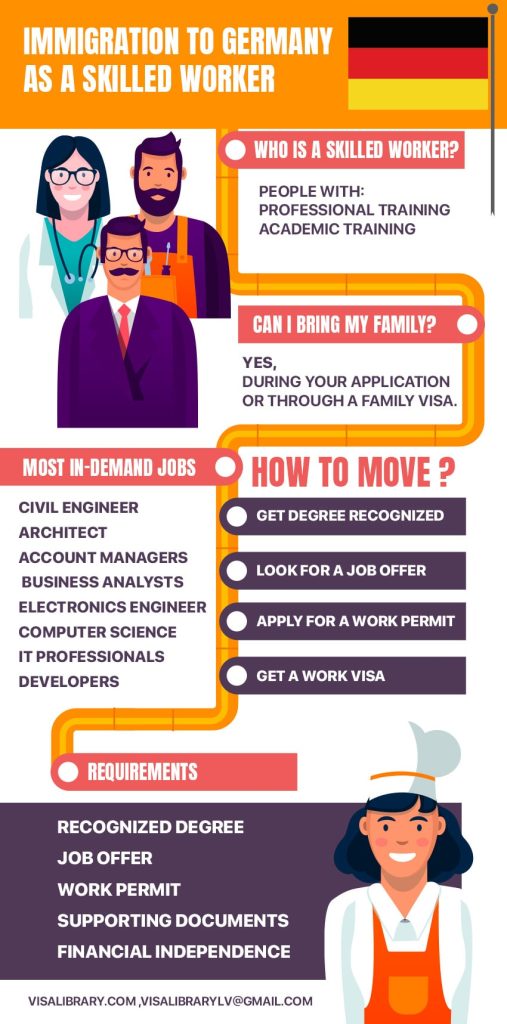
Skilled worker immigration Germany has become a focal point in the nation’s efforts to attract international talent amidst growing labor shortages. Despite Germany’s liberal immigration policies designed to welcome foreign skilled workers, recent statistics reveal a surprising shortfall in their uptake. Initiatives such as the EU Blue Card and the newly introduced Chance Card Germany aim to alleviate this gap by providing streamlined pathways for qualified individuals. However, ongoing debates surrounding immigration create a challenging environment, potentially hindering the effectiveness of these programs. As the demand for skilled professionals continues to rise, addressing the barriers to effective labor migration has never been more critical.
The process of inviting qualified professionals from abroad to work in Germany has often been referred to as labor migration. Within this context, the country has established various programs and incentives, including the sought-after EU Blue Card. Despite these well-structured options, many foreign skilled workers have yet to take advantage of the opportunities presented by Germany’s immigration frameworks. Recent discussions emphasize the importance of cultivating a true welcoming culture as a prerequisite for successful foreign worker integration. As Germany grapples with its workforce challenges, understanding the nuances of these immigration strategies becomes essential.
The Current State of Skilled Worker Immigration in Germany
Despite Germany’s liberal immigration policies aimed at attracting foreign skilled workers, the current statistics reveal a less than favorable reality. Recent reports indicate that while the number of foreign skilled laborers is on the rise, it is still falling short of the anticipated influx needed to meet labor market demands. The federal government has noted that although 690,000 non-EU third-country nationals were employed in shortage occupations at the start of 2024, the overall growth of skilled worker immigration is not keeping pace with predictions or the nation’s requirements.
The discrepancies in migration numbers highlight the complexities within Germany’s immigration system, which, while made more accessible through policy reforms, has not significantly transformed the landscape of labor migration. For a country with one of the most progressive immigration frameworks, it is paradoxical that many vacancies in sectors demanding urgent staffing remain unfilled. The focal point of criticism lies in the perception that Germany is not sufficiently advertising its opportunities, resulting in an unattractive image to potential migrants.
Frequently Asked Questions
What are the key benefits of skilled worker immigration to Germany?
Skilled worker immigration to Germany allows foreign professionals to fill labor shortages in various sectors, contributing to economic growth and innovation. The EU Blue Card enables highly qualified individuals to work in Germany while offering benefits such as family reunification and a pathway to permanent residency.
How has Germany’s immigration policy changed to attract foreign skilled workers?
Germany’s immigration policy has become more welcoming, significantly lowering legal hurdles for foreign workers. Reforms include the introduction of the EU Blue Card, the Experience Pillar for skilled workers without recognized qualifications, and the Chance Card, allowing foreigners to seek employment based on certain criteria.
What is the Chance Card for skilled worker immigration in Germany?
The Chance Card is designed to facilitate skilled worker immigration by allowing qualified foreigners to enter Germany without a job offer and search for employment. Introduced in 2024, it aims to attract professionals by providing more accessible pathways to work in Germany.
Why is skilled worker immigration to Germany not meeting expectations?
Despite reforms aimed at enhancing skilled worker immigration, actual numbers remain low due to ongoing anti-migration sentiments and inadequate promotion of available pathways. Many skilled workers are unaware of their options, and the perception of Germany as less attractive for immigration contributes to these challenges.
How does the EU Blue Card support skilled workers looking to move to Germany?
The EU Blue Card allows non-EU skilled workers with higher education qualifications to live and work in Germany. This residence permit provides benefits such as the ability to bring family members, access to social benefits, and a pathway to permanent residency after a certain period of employment.
What progress has been made in Germany regarding labor migration as of 2023?
As of 2023, Germany has seen a notable increase in the number of non-EU foreigners in shortage occupations, with significant national visa issuances. However, overall immigration numbers from outside the EU remain below government predictions, indicating a need for further improvements in workforce integration.
What role does the Work-and-Stay Agency play in skilled worker immigration?
The Work-and-Stay Agency is planned to serve as a central hub for supporting foreign workers and domestic employers in navigating the immigration process. Its creation aims to streamline procedures and enhance the overall effectiveness of skilled worker immigration to Germany.
What challenges do non-academic skilled workers face in the skilled worker immigration process?
Non-academic skilled workers face challenges such as limited awareness of the Experience Pillar, which allows for immigration without prior recognition of qualifications. The take-up rates for available programs indicate that more outreach and support are necessary to encourage participation.
How effective have recent immigration reforms been for skilled worker immigration in Germany?
While recent reforms have made Germany’s immigration framework one of the most liberal globally, the effectiveness in increasing the influx of skilled workers is still under scrutiny. Reports indicate that the anticipated structural changes in labor migration have yet to manifest significantly.
What future initiatives are planned to enhance skilled worker immigration to Germany?
Future initiatives include the establishment of the Work-and-Stay Agency, which aims to simplify the skilled worker immigration process in Germany. This agency is expected to provide clearer pathways and improved support for foreign skilled workers seeking employment in Germany.
| Key Points | Details |
|---|---|
| Skilled Worker Immigration Issues | Foreign workers are not utilizing immigration options as expected, with low numbers coming to fill vacancies. |
| Liberal Immigration Laws | Germany has one of the most liberal immigration laws but still lacks a significant influx of skilled workers. |
| Government Response | Discourse around migration is critiqued by political figures; the government is encouraged to enhance welcoming culture. |
| Visas Issued | The number of visas for skilled workers has decreased, indicating challenges in attracting talent. |
| The Chance Card | Introduced to attract labor migrants, but issuance is below expectations compared to targets. |
| Future Developments | A new Work-and-Stay Agency is planned to streamline the immigration process, but its implementation is delayed. |
Summary
Skilled worker immigration Germany is intended to be a pathway for qualified individuals to contribute to the German labor market, yet current data reveals a concerning lack of effective implementation. Despite liberal immigration policies and various initiatives like the Chance Card, the influx of skilled workers remains insufficient. The recent discussions and proposals from government officials highlight the urgency to create a truly welcoming environment that actively promotes immigration and addresses the existing barriers. To realize the potential of skilled worker immigration, Germany must enhance its outreach and adapt its policies to attract global talent effectively.

