
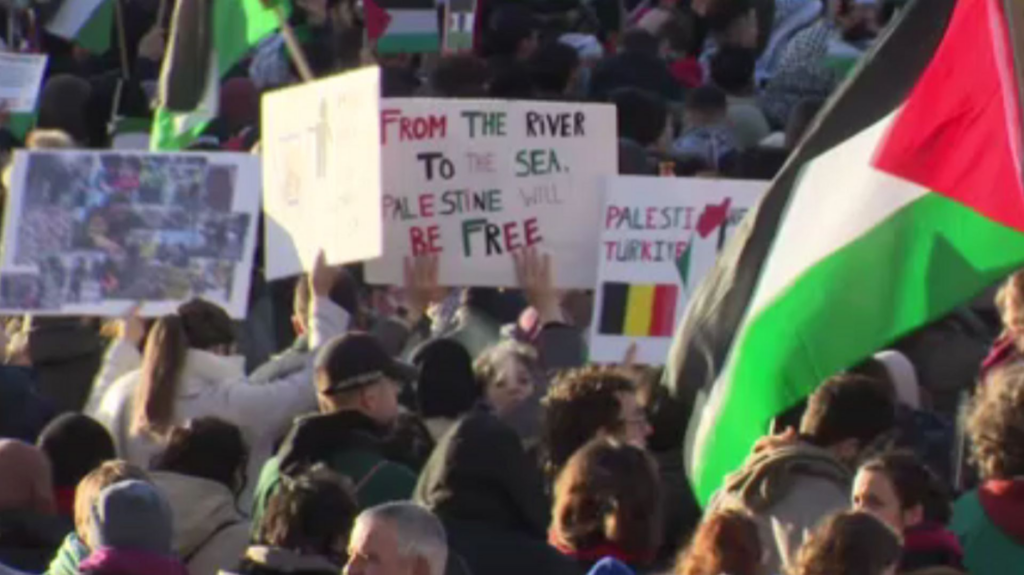
The Palestine slogan controversy has sparked intense debate and legal scrutiny, particularly following a recent court ruling in Berlin. The phrase “From the river to the sea, Palestine will be free,” has been deemed a symbol associated with Hamas, leading to significant legal implications for those who chant it during pro-Palestinian demonstrations. In a pivotal decision, the Berlin District Court labeled the slogan as a support for terrorism, a ruling that may soon be reviewed by the Federal Court of Justice. This controversy is crucial not only for its legal ramifications, following the specific guidelines outlined in the legal assessment of Palestine slogans but also for its potential influence on future pro-Palestinian sentiments in Germany. As more cases arise, the outcome of the Federal Court’s deliberation will likely bring much-needed clarity to this divisive issue.
The recent turmoil surrounding the contentious phrase associated with Palestinian identity and aspirations has gained traction in legal circles and public discourse. Referring to this heated issue as the Palestine slogan debate reveals the multifaceted nature of the discussions it incites. Certain segments of society view the slogan as an expression of solidarity, while others frame it within the context of terrorism, especially following significant geopolitical events. The ruling by the Berlin District Court introduced legal complexities around public expressions of this nature, reflecting broader tensions in the legal classification of such symbolic speech. Ultimately, how courts interpret these slogans could significantly affect freedom of expression at demonstrations and the ongoing dialogue surrounding Palestinian rights.
Understanding the Controversy Over the Palestine Slogan
The controversial slogan “From the river to the sea, Palestine will be free” has ignited significant debate regarding its legal implications and association with terrorism. Courts in Germany have recently ruled against individuals who chanted this phrase during pro-Palestinian demonstrations, leading to criminal convictions based on laws pertaining to the support of terrorist organizations, specifically Hamas. Legal assessments have varied, with the Berlin District Court emphasizing that using this slogan can be interpreted as endorsing Hamas’s violent agenda against Israel.
In Berlin, a 25-year-old individual was found guilty of promoting terrorist propaganda for chanting this phrase and received a substantial fine, highlighting the court’s position that this slogan implies a call for violence against the state of Israel. As this case progresses to the Federal Court of Justice, it raises critical questions about the limits of free speech and the interpretations of pro-Palestinian sentiments within the context of Germany’s legal framework. The ruling is crucial and could set a precedent for future cases involving similar slogans.
The Legal Landscape of Palestinian Activism in Germany
The legal landscape surrounding pro-Palestinian activism in Germany has been a point of contention, especially following recent court decisions that classify certain expressions of solidarity with Palestine as supportive of terrorism. Under current German law, expressions that can be associated with organizations like Hamas carry significant legal repercussions. The recent rulings reflect a broader concern over national security and the implications of public support for groups that have historically been linked to violence against civilians.
The varying interpretations of slogans used in demonstrations have led to inconsistencies in how the law is applied across different regions within Germany. For instance, while one court may view a pro-Palestinian slogan as benign, another could classify it as a criminal act. This disparity underscores the need for a coherent legal framework that distinguishes between legitimate activism and expressions that cross lines into hate speech or support for terrorist actions. A definitive ruling from the Federal Court of Justice may provide the clarity required to navigate these complex legal waters.
The Impact of the Federal Court of Justice Decision
As the case surrounding the Palestine slogan reaches the Federal Court of Justice, its implications may redefine the boundaries of permissible expression within pro-Palestinian activism. This landmark decision will likely serve as a touchstone for understanding how Germany balances free speech with the prevention of hate speech and terrorism. With the ruling being highly anticipated, legal experts suggest it could establish clear guidelines for future pro-Palestinian demonstrations, aiming to protect lawful expressions while penalizing those that echo terrorist ideologies.
Many stakeholders, including activists, legal scholars, and government officials, are closely following the proceedings. A ruling that strengthens legal action against perceived support for Hamas might discourage participants at future pro-Palestinian demonstrations from voicing certain slogans, fearing legal repercussions. Conversely, a ruling in favor of free expression may embolden activists but could also raise concerns about the potential for increased tensions surrounding such public demonstrations, especially in a sensitive political climate.
Debating Free Speech vs. Anti-Terrorism Laws
The ongoing debate between the values of free speech and the necessity of anti-terrorism laws is at the heart of the controversy surrounding the Palestine slogan. Activists argue that the ability to express support for Palestine is a vital part of democratic society and essential for human rights advocacy. They contend that labeling expressions of solidarity as support for Hamas stifles legitimate political discourse and equates peaceful protest with terrorism.
On the other side, proponents of stringent anti-terrorism measures advocate for a strict interpretation of legal language that aims to curb any public endorsement of groups linked to violence. They emphasize that protecting national security must take precedence over unfettered speech, especially when phrases tied to terrorist initiatives could incite future conflicts. This ongoing struggle reflects the challenges of navigating complex legal and ethical landscapes in today’s politically charged environment.
The Role of Public Sentiment and Media Influence
Public sentiment plays a crucial role in shaping legal interpretations and responses to the Palestine slogan controversy. Media coverage surrounding pro-Palestinian demonstrations often amplifies concerns regarding terrorism and security, leading to heightened scrutiny of how various slogans are perceived in the eyes of the law. As public opinion sways, so too can the judicial landscape, as courts may be influenced by societal pressures when deciding on cases involving contentious issues related to national identity and security.
Moreover, social media has emerged as a powerful tool for both advocacy and condemnation, influencing perceptions of legitimacy among various expressions of political support. The virality of certain phrases or images may quickly shift the narrative around demonstrations, leading to an amplified legal response. As seen in the escalation of legal actions against individuals like the 25-year-old in Berlin, the interplay between media portrayal, public advocacy, and legal frameworks continues to evolve, warranting closer examination of these multifaceted interactions.
Consequences of Misinterpretation in Legal Settings
The misinterpretation of political slogans, such as the one in question involving Palestine, can have significant legal ramifications. Courts that classify such expressions as supportive of terrorist acts risk creating a chilling effect on activism, discouraging individuals from participating in demonstrations for fear of legal repercussions. This not only undermines the right to protest but also raises significant concerns about the fairness of legal assessments based on potential misunderstandings of political expressions.
Additionally, as seen in the case of the Berlin District Court’s ruling, the classification of a seemingly benign slogan can lead to serious criminal charges, like spreading propaganda for terrorist organizations. A careful legal assessment is required to distinguish between legitimate political expression and those that cross the line into supporting violent ideologies. These nuances are essential for ensuring that the law is applied justly, and that free speech rights are not unwittingly curtailed by hasty or misinformed legal interpretations.
The Future of Pro-Palestinian Demonstrations in Germany
Looking ahead, the future of pro-Palestinian demonstrations in Germany will largely depend on the outcomes of ongoing legal debates and potential rulings by the Federal Court of Justice. Should the court uphold the rulings against the controversial slogan, it may deter individuals from voicing their support for Palestine, thus altering the landscape of political activism in Germany. Conversely, a ruling favoring free expression could invigorate participation in demonstrations, fostering a more vibrant discourse around Palestinian rights.
Moreover, the decisions made in these cases will likely set precedents that could influence how free speech laws are interpreted across various political groups and movements. As activists prepare for future demonstrations, the legal climate surrounding expressions of political support will be pivotal in determining the efficacy and safety of those involved. Ultimately, the careful consideration and balancing of free expression rights against anti-terrorism efforts will shape the trajectory of public demonstrations for years to come.
Judicial Precedents and Their Influence on Future Cases
Judicial precedents established in cases related to the Palestine slogan controversy will significantly influence how similar future cases are handled by the court system. Legally binding decisions from the Federal Court of Justice could crystallize interpretations of what is deemed acceptable in political discourse, impacting not just pro-Palestinian movements but other activist expressions as well. The rulings may determine whether expressions perceived as sympathetic to groups like Hamas will be continually scrutinized or if broader protections for freedom of expression will prevail.
As legal experts analyze the implications of these judicial decisions, they highlight the importance of clarity in the law to protect both freedom of speech and national security interests. A coherent legal principle could foster an environment where individuals feel safe and unencumbered in expressing their political beliefs without fear of criminal repercussions. Thus, the outcomes in these cases will not only affect the immediate context of Palestinian activism but also the broader principles governing political expression in Germany.
Political Symbolism and Its Interpretation in the Legal Realm
Political slogans often carry deep symbolic meanings that can vary drastically between communities and contexts, which complicates their interpretation in the legal realm. In the case of the Palestine slogan, perceptions that link it to Hamas symbolize a broader narrative of conflict and resistance. However, many supporters argue that it represents aspirations for self-determination and freedom, rather than a direct endorsement of violence. The challenge lies in navigating these diverse interpretations within legal frameworks aimed at mitigating terrorism.
Legal rulings that fail to adequately account for the symbolic nature of political expressions risk oversimplifying complex socio-political issues. The need for courts to consider the intent and context behind such slogans becomes paramount to ensure a balanced approach that respects both freedom of expression and public safety from potential violence. As the legal definitions evolve, so too must the approaches to interpreting political symbolism to preserve the integrity of democratic discourse.
Frequently Asked Questions
What is the legal status of the controversial Palestine slogan ‘From the river to the sea’?
The legal assessment of the Palestine slogan ‘From the river to the sea’ is complex and has seen varying interpretations across different courts. Notably, the Berlin District Court recently classified it as a symbol associated with Hamas, leading to a conviction for a man who chanted it during a pro-Palestinian demonstration. This ruling indicates that using the slogan may be criminalized, especially in light of its connection to terrorist organizations.
How does the Federal Court of Justice impact the Palestine slogan controversy?
The Federal Court of Justice is expected to provide a definitive legal ruling on the Palestine slogan controversy. Current rulings, such as the one from the Berlin District Court, indicate that the slogan is associated with Hamas, thus creating legal ambiguity. A supreme court decision will clarify the legal ramifications for future pro-Palestinian demonstrations and similar expressions.
What recent court ruling affected the usage of the Palestine slogan in Germany?
A recent ruling by the Berlin District Court significantly impacted the perception of the Palestine slogan in Germany. The court classified the slogan as a symbol of Hamas, leading to a conviction and fine for an individual who used it during a pro-Palestinian demonstration. This decision contributes to the ongoing debate about the legality of such expressions in the context of Germany’s counter-terrorism laws.
How has public perception of the Palestine slogan changed after the October 7 attacks on Israel?
Following the October 7 attacks on Israel, public perception of the Palestine slogan ‘From the river to the sea’ has shifted considerably. It is now widely recognized as being associated with Hamas and its objectives, which include the destruction of Israel. This shift has influenced legal assessments and the ramifications for those who chant or promote the slogan in demonstrations.
What were the circumstances of the Berlin District Court’s ruling on the Palestine slogan?
The Berlin District Court’s ruling on the Palestine slogan emerged from a demonstration where a 25-year-old man was found guilty of supporting Hamas by chanting it. The court deemed the slogan a clear endorsement of terrorist actions, reflecting a legal trend where such expressions are increasingly scrutinized and penalized, especially amid heightened sensitivities following violent conflicts.
Why is the Palestine slogan important in legal debates in Germany?
The Palestine slogan ‘From the river to the sea’ has become a focal point in legal debates in Germany due to its associations with Hamas and the implications for free speech versus national security. The varying court rulings highlight the complexities of balancing democratic freedoms with the response to terrorism, making this slogan a crucial test case in the legal landscape.
What implications do court cases regarding the Palestine slogan have on future demonstrations?
Court cases regarding the Palestine slogan have significant implications for future demonstrations in Germany. As courts increasingly classify the slogan as linked to Hamas and terrorism, activists may face legal repercussions for using it, raising concerns about the limits of free expression in political discourse, particularly in pro-Palestinian contexts.
| Key Points |
|---|
| The slogan ‘From the river to the sea, Palestine will be free’ is controversial and legally assessed differently by various courts in Germany. |
| A Berlin District Court has classified the slogan as a symbol of Hamas, associating it with the terrorist organization’s goals. |
| A 25-year-old was found guilty of chanting the slogan at a demonstration and was fined a total of 2700 euros. |
| The ruling could potentially lead to a supreme court decision that clarifies the legal status of the slogan regarding demonstrations. |
| The case illustrates the varying interpretations of the slogan across different criminal courts in Germany, with no supreme court ruling yet. |
| The accused also shared social media photos glorifying violence, associated with terrorist organizations like the Al-Aqsa Martyrs Brigade. |
Summary
The Palestine slogan controversy has surged into the legal spotlight, particularly with the recent ruling from a Berlin District Court classifying the slogan ‘From the river to the sea, Palestine will be free’ as a supportive statement for Hamas, thus highlighting the ongoing debates around freedom of expression and its limitations in the context of terrorism. This case reflects the critical need for a clear judicial stance on such slogans to ensure legal consistency and the protection of public order.