
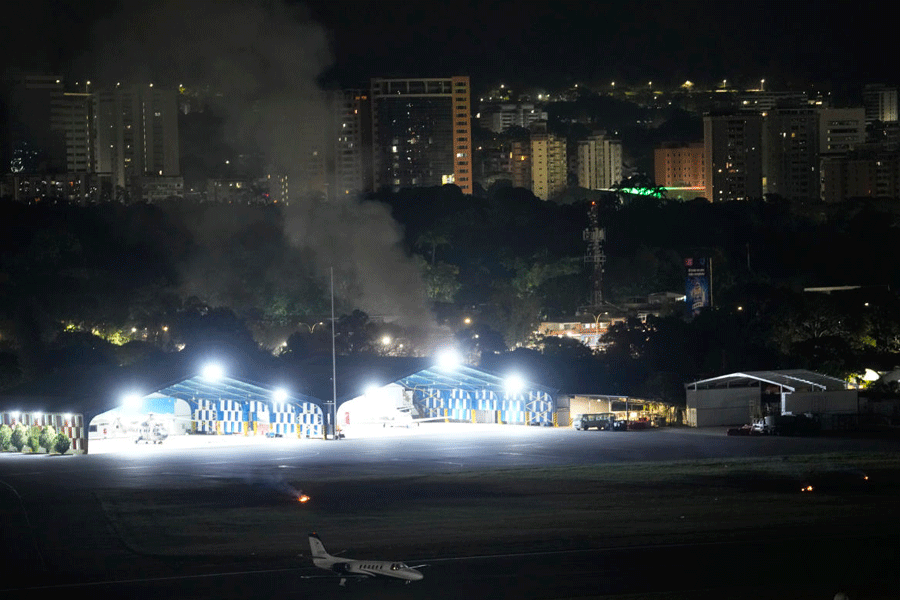
In recent news, the unfolding situation in Venezuela has been marked by a series of alarming explosions that rocked the capital, Caracas. This crisis prompted the government to declare a state of emergency, with officials alleging that the explosions were part of a coordinated Venezuelan military attack linked to US involvement in Venezuela. Witnesses reported seeing clouds of smoke and hearing loud airplane noises just after 2 AM, stirring fears among the local population. President Nicolás Maduro responded strongly to these events, blaming the United States for instigating conflict and calling upon citizens to mobilize in the streets. The U.S. Embassy has since issued a travel warning, advising Americans to steer clear of Venezuela amid the heightened tensions and emergency policies that are now in effect.
The dramatic events unfolding in Venezuela, particularly in the heart of Caracas, can be described as a significant escalation of hostilities which have historically strained US-Venezuela relations. Local authorities have indicated that these explosive incidents signal a serious military affront, leading to widespread panic as citizens navigate the chaotic aftermath. In light of this turbulence, global eyes remain fixed on President Nicolás Maduro and his government’s responses, including the urgent mobilization of residents to address the crisis. Furthermore, international observers are taking note of the implications of such military activities on both regional stability and travel advisories for those considering visiting the country. Overall, the interplay between military actions and governmental declarations has sparked extensive discussions about the future of Venezuela and its geopolitical standing.
Recent Explosions in Venezuela: A State of Emergency
In the capital city of Caracas, recent explosions have escalated tensions and led the Venezuelan government to declare a state of emergency. Reports indicate that several explosions rocked the city around 2 AM, creating chaos and panic among residents. Accompanying the explosions were loud airplane noises overhead, which further heightened fears about the potential for military involvement. Social media platforms buzzed with images showcasing massive clouds of smoke billowing into the night sky, and accounts of fires erupting in various locations have saturated news cycles. Witnesses have also reported power outages in southern Caracas, adding to the bleak situation in an already tumultuous environment.
The Venezuelan government has accused the United States of orchestrating these explosions, labeling them as a “severe military attack.” This accusation is rooted in heightened anxieties regarding U.S. involvement in the region, which President Nicolás Maduro openly laments as an infringement on Venezuela’s sovereignty. The situation serves as a stark reminder of the fragility of peace in the country, where political and military tensions continue to fester. Given the current state of emergency, citizens have been urged to mobilize and remain vigilant as the government seeks to manage the fallout from this alarming incident.
Nicolás Maduro’s Response to U.S. Accusations
In light of the explosions and subsequent accusations directed at the U.S., President Nicolás Maduro has taken a defiant stance. He declared a state of emergency and rallied citizens to respond to what he calls a direct threat to Venezuela. Maduro’s rhetoric has consistently suggested that U.S. military interventions are a strategy to gain control over the country’s rich oil and mineral resources. His framing of the situation portrays an image of Venezuela standing resolute against foreign aggression, appealing to national pride amidst chaos.
Maduro’s administration’s claims are not without context; the U.S. has had a contentious relationship with Venezuela for years. Recent reports of military ships positioning near the Venezuelan coast only serve to fortify the belief among many Venezuelans that the U.S. is indeed a looming threat. The Venezuelan government’s narrative aims to unify citizens against perceived external interference while simultaneously bolstering its own legitimacy in the face of serious domestic challenges.
The Potential Impact of U.S. Military Involvement
The prospect of U.S. military involvement in the Venezuelan crisis, particularly following the explosions in Caracas and La Guaira, has significant implications for regional stability. There are ongoing fears that such intervention could spiral into broader conflict, drawing in neighboring countries and creating a humanitarian catastrophe. The perception of foreign military presence often leads to increased hostilities, making diplomatic resolutions more challenging.
Furthermore, recent statements from U.S. officials hinting at military options have alarmed not only Venezuelans but also international observers. The history of U.S. interventions in Latin America has instilled a deep wariness about the motives behind such actions, often driven by a quest for resource acquisition. This complicated dynamic paints a grim picture for Venezuela, where citizens are already struggling with severe economic hardships and political unrest.
Travel Warnings for U.S. Citizens in Venezuela
In response to the escalating violence and military activities in Venezuela, the U.S. Embassy issued a stern travel warning, advising American citizens against any travel to the country. This decision underscores the increasing danger posed by the recent explosions and ongoing military tensions. The FAA’s closure of Venezuelan airspace to commercial U.S. flights is a proactive measure, intending to safeguard American lives amidst escalating turmoil.
Potential travelers are admonished to consider the risks seriously, as the country grapples with civil unrest and security threats. The travel warning emphasizes the U.S. government’s reluctance to put citizens in harm’s way, reinforcing the notion that safety is an immediate priority. Travelers with plans to visit Venezuela are advised to re-evaluate their itineraries and seek information regarding the evolving situation before making any commitments.
Analyzing the Allegations of U.S. Involvement
The Venezuelan government’s allegations of U.S. involvement in the recent explosions have generated significant scrutiny. The narrative put forth by Maduro paints the U.S. as an aggressor, aiming to destabilize the nation for its own gain. This accusation is particularly provocative in the context of historical events, where various Latin American countries have faced interventions for geopolitical reasons, raising questions about the validity of these claims and the actual intent behind U.S. military posturing in the region.
Journalists and analysts are dissecting these claims, attempting to discern the truth behind the explosions and the potential role of foreign powers. Investigations into the timeline of events and corroborative evidence could shed light on whether these incidents were indeed orchestrated as part of a broader military strategy. The international community watches closely, wary of the implications that further escalation could have not only for Venezuela but also for regional stability in Latin America.
The Systematic Impact of Explosions on Caracas
The explosions that rocked Caracas are more than just an immediate crisis; they illustrate a systematic unraveling within the city and the nation as a whole. Infrastructure damage, public fear, and economic repercussions can linger long after the chaos subsides. As citizens confront the reality of power outages and emergency measures, the broader implications for everyday life in Caracas become evident—challenges that citizens will have to grapple with for the foreseeable future.
Local businesses, particularly those reliant on electricity and stability, may face devastating consequences as conditions worsen. The economic implications could lead to increased poverty and a further decline in living standards, exacerbating an already dire humanitarian situation. As the Venezuelan government focuses on responding to the immediate crisis, the underlying issues that led to this environment of vulnerability must also be addressed to avoid future disasters.
The Role of Social Media During Crises
In the digital age, social media has become an influential platform for disseminating information and rallying public opinion during crises such as the recent explosions in Venezuela. Videos and images shared online have played a crucial role in depicting the chaos on the ground, allowing the world to witness firsthand the severity of the situation in Caracas and La Guaira. Social media also serves as a tool for solidarity among citizens, uniting them in the face of adversity and fostering a communal response to the escalating dangers.
However, the rapid spread of information also presents challenges, as misinformation can exacerbate panic and lead to public unrest. Navigating the fine line between factual reporting and sensationalized coverage is crucial for both media outlets and citizens alike. Government reactions to social media reports will also be watched closely, highlighting how information flow can influence not only local but also international perceptions of the events unfolding in Venezuela.
International Reactions to the Venezuelan Crisis
The international community’s response to the Venezuelan crisis, particularly the recent explosions, has been varied and revealing. Countries with historic ties to Venezuela often express solidarity with Maduro’s administration while others vehemently denounce the actions of both the government and the alleged foreign aggressors. This division reflects broader geopolitical tensions that significantly influence international relations in the region, as global powers jockey for influence in the face of Venezuelan instability.
Organizations and foreign governments are monitoring the situation closely, assessing the implications of U.S. military activity and the Venezuelan government’s fierce rhetoric against perceived threats. The response from the UN and regional cooperation bodies will be critical in shaping the future direction of diplomatic efforts, as they address not just the immediate crises but the long-term stability of Venezuela and its people.
Lessons from Venezuela’s Ongoing Crisis
As Venezuela navigates the labyrinth of its ongoing crisis, it serves as a critical case study for understanding the complexities of political unrest and military interventions. The patterns of governmental responses, public mobilization, and international involvement could provide insights for future situations in similar contexts around the world. Analyzing what has unfolded in Venezuela sheds light on the broader implications of governance, economic stability, and the role of foreign influence on national sovereignty.
Understanding the nuances of the Venezuelan crisis allows policymakers, analysts, and citizens alike to engage in meaningful discussions about global geopolitical dynamics. It emphasizes the need for robust dialogue about intervention ethics, national sovereignty, and human rights, providing a framework that can guide future actions and policy decisions in the sphere of international relations.
Frequently Asked Questions
What triggered the recent Venezuela explosions in Caracas?
The Venezuela explosions in Caracas were reportedly triggered by a significant military attack that the Venezuelan government attributed to the U.S. The explosions occurred around 2 AM local time, alongside the sound of aircraft overhead, leading to a declared state of emergency in the capital.
How has Nicolás Maduro responded to the Caracas emergency?
In response to the Caracas emergency following the explosions, President Nicolás Maduro declared a state of emergency and accused the U.S. of orchestrating a military attack. He urged citizens to take to the streets in mobilization efforts against what he termed a foreign incursion.
What is the US government’s stance on the Venezuela explosions?
As of now, the U.S. government has not made any official statements regarding the Venezuela explosions. However, numerous reports have surfaced indicating potential U.S. military involvement in the attacks, as tensions between the U.S. and Venezuela continue to escalate.
What areas in Venezuela were affected by the explosions aside from Caracas?
In addition to Caracas, the explosions were reported in the coastal town of La Guaira, along with impacts felt in the states of Miranda and Aragua. The blasts resulted in power outages, particularly in southern Caracas near a large military base.
What does the US travel warning regarding Venezuela entail?
Following the recent violence, the U.S. Embassy issued a travel warning advising American citizens against traveling to Venezuela. This warning is a precautionary measure due to the ongoing military activities and unrest following the Venezuela explosions.
What are the potential implications of U.S. involvement in the Venezuelan military attack?
Potential implications of U.S. involvement in the Venezuelan military attack could escalate tensions significantly, leading to heightened conflict. The Venezuelan government claims the attacks aim to seize control over the nation’s oil and mineral resources, increasing geopolitical instability in the region.
How did media report on the spectacular explosions in Venezuela?
Media outlets, including AP and Reuters, reported on the Venezuela explosions, describing them as multiple blasts accompanied by visible smoke and fires. Many images and videos circulated on social media, showcasing the chaos experienced in Caracas and La Guaira post-explosions.
Is there a military presence near Venezuela due to the recent explosions?
Yes, tensions after the Venezuela explosions have drawn U.S. warships closer to the Venezuelan coast. This increased military presence may indicate preparations for possible further actions amidst the rising conflict between Venezuela and the U.S.
| Key Point | Details |
|---|---|
| Explosions in Caracas | Several explosions occurred in Caracas around 2 AM, causing significant damage. |
| State of Emergency Declared | The Venezuelan government declared a state of emergency following the explosions. |
| Accusations Against the U.S. | The government accused the U.S. of being behind the explosions, labeling it a “severe military attack.” |
| Reports of Power Outages | Power outages were reported in southern Caracas and La Guaira, affecting many residents. |
| U.S. Military Involvement | Anonymous sources claimed that the U.S. military was involved in the attacks. |
| Travel Warnings Issued | The U.S. FAA closed Venezuelan airspace to commercial flights and issued travel warnings. |
| Call to Mobilize | President Nicolás Maduro encouraged the citizens of Venezuela to take to the streets. |
Summary
The Venezuela explosions have revealed a significant escalation in tensions between the U.S. and Venezuela, emphasizing the dire situation in the region. With the Venezuelan government accusing the U.S. of a military attack, the international community is urged to closely monitor further developments. The atmosphere in Venezuela remains precarious, following the declarations of states of emergency and travel warnings for U.S. citizens.

